
Your new grads are more uncertain than they’re letting on.
She tried our simulator at a nursing conference and loved it.
As we were talking, she got quiet for a second and told me about her very first med pass as a new grad six months earlier. Her preceptor assumed she had medication administration down from nursing school, pointed her toward the medication room, and sent her off on her own.
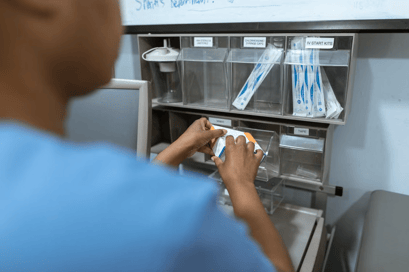 She prepared the medications. She administered them. She got through it.
“I sure hope I did it right.”
She probably did. I genuinely hope so.
But she wasn’t sure. And nobody knew to check.
That’s the problem.
New graduate nurses arrive at residency programs with real knowledge and real heart. What many are missing is enough practice with the actual workflow -- the pressure, the interruptions, the decisions -- to feel truly confident when it counts.
That gap is exactly what nurse residency programs are positioned to close.
The Uncomfortable Truth
Here’s the uncomfortable truth: that story is not rare.
Most new graduate nurses leave nursing school with solid knowledge and shaky confidence. They know the five rights. They understand pharmacology. But knowing and doing are two very different things -- especially when you’re alone in a medication room for the first time with three patients waiting.
Nursing school simply cannot replicate the real conditions of medication administration. The interruptions. The time pressure. The unfamiliar medications. The moment you have to decide whether to call the provider or just figure it out yourself.
Those skills don’t come from a textbook. They come from practice.
And here’s where residency programs often have an unintentional gap: medication administration competency is frequently assumed, not verified. Nurses graduate, they pass their NCLEX, and the expectation is that med admin is covered.
But “covered in school” and “confident in practice” are not the same thing.
Why Medication Administration Is Uniquely Hard to Learn in the Classroom
Medication administration looks straightforward on paper. Check the order. Pull the medication. Scan the armband. Administer. Document.
But that’s not what it actually looks like at 0800 when four patients’ medications are due at the same time, a call light is going off, and a family member is standing in the doorway with questions.
Medication administration isn’t a single skill. It’s a complex clinical workflow -- and workflows have to be practiced under realistic conditions to stick.
What trips up new grads isn’t usually knowledge. It’s the conditions:
- The interruption that breaks their concentration mid-scan
- The high-alert medication that makes their hands shake a little
- The unclear order they’re not sure they should question
- The documentation timing they haven’t quite figured out yet
- The creeping feeling that they’re already behind
A check-off in skills lab doesn’t prepare a nurse for any of that. Neither does watching someone else do it.
Realistic, repeated practice does.
Where Residency Programs Have a Unique Opportunity
Here’s the good news: residency programs sit at the most important window of opportunity in a new nurse’s career.
Not before graduation. Not six months into independent practice. Right now -- during residency -- before uncertainty becomes a habit and before a near-miss becomes a defining moment.
This is the time to reinforce safe medication administration workflow. Not remediate errors. Prevent them.
And it doesn’t require a dedicated simulation center, expensive equipment, or adding another three-hour session to an already packed orientation schedule.
Effective simulation doesn’t have to be elaborate. But it does have to be realistic. That means it looks less like this:
- Reciting the five rights
- Completing a paper check-off
- Watching a demonstration
And more like this:
- A nurse is mid-scan when a call light goes off, and a family member walks in -- what do they do?
- Two patients need pain medication at the same time -- who goes first and why?
- An order doesn’t look right -- do they give it or make the call?
- A medication is one they’ve never seen before -- how do they respond?
These are the moments that matter. Brief and repeated beats long and occasional every time. Ten focused minutes of realistic practice is worth more than an annual simulation marathon.
Good simulation also includes what happens after the medication is administered. The reassessment. The documentation. The communication with the care team. Medication administration doesn’t end at the bedside.
The Bigger Goal
The best thing you can do for a new graduate nurse isn’t to tell them medication administration is important.
They already know that. It’s why they’re terrified.
The best thing you can do is give them a safe place to practice it -- with the interruptions, the pressure, and the uncertainty included -- before a real patient is on the other end.
When new grads feel prepared, they make fewer errors. They stay longer. And they don’t walk away from their first solo medication pass hoping they got it right.
They know they did.
FREE RESOURCE 💊
Ready to try it with your residency cohort? We’re sharing our Medication Administration Under Pressure disruption simulation -- completely free. It’s a realistic, ready-to-run scenario that takes about 20 minutes and requires no special equipment.
Download the Free Med Disruption Sim Scenario
Want to see how Sim2Grow supports medication administration training at scale? We’d love to show you. Schedule your free demo here!

.webp?width=352&name=s%20(4).webp)