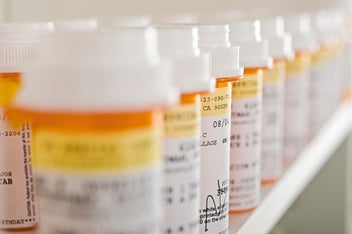
We've all felt it. That half-second of doubt standing at the med cart, hand hovering over a vial, double-checking a name that looks almost right. If you've been at the bedside for more than a few shifts, you know exactly the feeling I mean. That instinct to pause is one of the most important things we develop as nurses, and Look-Alike Sound-Alike (LASA) drugs are exactly why it matters.
LASA medications are drugs whose names look nearly identical on paper or sound nearly identical out loud. We break them into two categories:
- Look-alike: similar packaging, labeling, or physical appearance — size, shape, color, the works.
- Sound-alike: names close enough phonetically that a verbal order or a hurried handoff can turn one drug into another.
We're on the front lines of both dispensing and administering, which means we're often the last line of defense against a LASA mix-up — and also the ones left holding the consequences when the system doesn't catch it first.
The Numbers Are Bigger Than Most of Us Realize
The Institute for Safe Medication Practices (ISMP) has identified hundreds of drug name pairs prone to confusion, and the research backs up what most of us already sense from experience: LASA errors are common, not rare. Some studies estimate they account for as much as 25% of all reported medication errors — and the harm isn't limited to a documentation headache. We're talking adverse reactions, extended hospital stays, and in the worst cases, patient deaths.
Many of us can probably think of pairs that have tripped us up, or tripped up a colleague: hydroxyzine and hydralazine, Humalog and Humulin, Celebrex and Celexa. Different classes, different effects, names close enough to catch even a careful nurse on a bad night.
A Case We Can't Not Talk About
If you've been in nursing during the last few years, you already know the name RaDonda Vaught. She's the Tennessee nurse who administered vecuronium, a paralytic, instead of the ordered sedative Versed — a mix-up that occurred after an automated dispensing cabinet override put both medications within reach during a name search. The patient went into cardiac arrest and suffered permanent brain death. RaDonda was later criminally charged and convicted of negligent homicide.
That case landed hard for nurses everywhere, and for good reason. Yes, there were multiple system failures at play — the override, alert fatigue, a malfunctioning cabinet. But a LASA-related name mix-up was part of the chain, and the individual nurse bore the full weight of the outcome. It's a hard case to sit with, and it's exactly the kind of story worth revisiting with our students and each other, not to scare anyone, but because it's real, and it's instructive.
Where the Error Actually Happens
LASA mistakes don't have one single point of failure — they can slip in at nearly every step of the medication process:
- Prescribing — a dropdown in the EHR autocompletes to the wrong drug, or a verbal order gets misheard.
- Transcribing — a name is misread or mistyped moving between systems.
- Dispensing — similar-looking packaging sitting on adjacent shelves leads to the wrong pull.
- Administering — under time pressure, we prepare or deliver the wrong medication.
- Monitoring — after the fact, we don't recognize an adverse reaction quickly enough as a sign something upstream went wrong.
Barcoding, double-check systems, and electronic verification all help close these gaps. But no system replaces the trained instinct to slow down at exactly the right moment — and that instinct has to be built, not assumed.
Building That Instinct Before It's a Real Patient
This is where I think simulation training earns its place, and it's the idea behind Sim2Grow's medication administration simulator.
Reading a list of LASA pairs helps us recognize them on paper. It doesn't build the split-second hesitation we need when our hand is already reaching for the vial. That's the gap the simulator is designed to close:
- Repeated exposure to real name pairs, so students build the kind of visual and verbal memory that holds up under pressure, not just on a quiz.
- A safe place to get it wrong — mistakes inside the simulation carry zero patient risk and immediate teaching value, instead of zero consequence until it's too late.
- Correction in the moment — if a student scans or selects the wrong medication, the simulator flags it right away and sends them back to the cart to try again, while the reasoning is still fresh.
- Pressure that mirrors what we actually face — the scenarios where LASA errors happen aren't calm ones. Simulation recreates that urgency so students practice the discipline of double-checking exactly when it's hardest to do.
- Repetition until it's automatic — safe medication administration isn't something we learn once. It's a habit built through reps, the same way we built ours.
The Takeaway
We already know the risk. Most of us learned it the hard way, or heard about it from someone who did. What separates a close call from a tragedy is whether that knowledge has actually been trained into muscle memory before a real patient is on the other end of the syringe. That's the standard we should be holding our programs to — and it's the standard we're building toward with every simulation a student runs before they ever touch a real medication cart.