For eight years, my job was to move students from “I understand pharmacology” to “I can pass meds safely under pressure.” Those are not the same skill, and I used to watch that gap show up in clinical. Now I'm watching it show up in licensure exam data too.
In 2024, the first-time NCLEX-RN pass rate hit 91.2 percent - the highest in over a decade, and the strongest full year of results since the Next Generation NCLEX launched. In 2025, it dropped to 86.7 percent: the largest single-year decline since the NGN began, and the lowest first-time pass rate since 2022. A lot of programs that had gotten comfortable are now asking the question I used to ask about clinical readiness: what are we actually measuring, and is it the right thing?
What the Next Gen NCLEX Is Actually Testing
The NGN is built around the NCSBN Clinical Judgment Measurement Model (NCJMM), which scores candidates on six cognitive processes: recognizing cues, analyzing cues, prioritizing hypotheses, generating solutions, taking actions, and evaluating outcomes. That's a meaningful shift from the old dichotomous right-or-wrong format. It isn't asking whether a student knows the content anymore. It's asking whether they can move through a full judgment sequence, in order, under uncertainty.
Traditional test prep is built to reinforce recall. The NGN is built to expose the students who have the content memorized but haven't practiced doing anything with it in sequence. That's precisely the population I spent eight years worrying about.
Where a Med Pass and the NCJMM Actually Overlap
I didn't fully connect this until I looked at the six NCJMM processes next to what actually happens during a single medication pass. They map almost one to one:
- Recognize cues. The eMAR flags a mismatch, or a barcode won't scan.
- Analyze cues. Is this a real discrepancy, or a scanning glitch? The student has to tell the difference before doing anything else.
- Prioritize hypotheses. Decide whether to hold the dose, re-verify, or escalate - and decide fast, because the patient in the next room is also waiting.
- Generate a solution and take action. The actual choice, made under time pressure, with a real consequence attached.
- Evaluate outcomes. Confirm the fix worked (the right dose reached the right patient) before moving on.
A single med pass, done right, forces a student through the entire NCJMM sequence in miniature. I don't think that overlap is a coincidence, and I don't think it's something a question bank can replicate.
Why I Don't Think the Pass Rate Drop Is Just Complacency
The easy explanation for 2025's decline is that the record year in 2024 made everyone - students and programs - a little less rigorous. I think that's part of it. But the deeper explanation is the same theory-practice gap I built my whole approach to readiness around: strong recall, undertrained judgment. The NGN was designed to find that gap. For a while, it was hiding in the pass-rate averages. It isn't anymore.
What I'd Tell a Program Director Today
If your strategy for moving your pass rate is another item bank, you're reinforcing the layer the NGN already assumes your students have. Repeatable, structured medication-pass simulation, the kind that forces a student through recognize-analyze-prioritize-act-evaluate under realistic interruption, is a much more direct lever on the specific competency the NCJMM is built to measure.
Where I'd Start, If This Were My Program
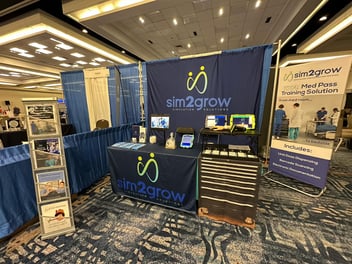
This is genuinely what I spend most of my time on now, working on a simulation tool that puts students through that exact judgment sequence, over and over, with behaviors faculty can actually watch and score. It's what we built the Sim2Grow Medication Administration Simulator to do, and I'd rather show you than describe it.
If you want to walk through it together, click this link to schedule a FREE demo.