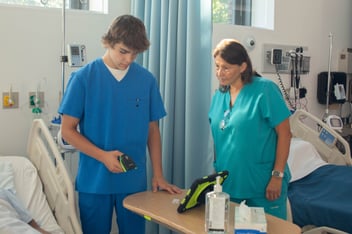
Almost everything I've written here has been aimed at the school side: faculty, program directors, curriculum committees. But every graduate nurse mentor and hospital educator I've talked with describes the exact same freeze I used to watch in clinical, just one year later and with higher stakes: a new grad who breezed through orientation competency checks locks up the first time a med pass gets interrupted on a real unit.
That freeze doesn't end at graduation. It just changes which building it happens in.
What the Data Says About the First Year
New graduate nurses experience medication errors at roughly 1.5 to 2 times the rate of their experienced colleagues during their first year of practice. That's not a knock on their preparation; it's the same theory-practice gap I spent eight years watching in nursing school, showing up again on a unit with real patient loads and none of the safety net a clinical instructor provides. Research on new grad transition consistently describes the same pattern: strong theoretical knowledge on paper, and a documented gap in confidence and judgment once real, unsupervised decisions start.
Why Hospital Onboarding Has the Same Blind Spot Nursing School Does
Most hospital orientation programs test the same thing most nursing programs test: can this nurse pass a medication math competency exam? That's the cognitive layer again; the one that's genuinely necessary and genuinely insufficient. It tells you almost nothing about whether a new hire can recover cleanly when a call bell interrupts a pass, or whether they'll stop and investigate an eMAR alert instead of overriding it because the unit is short-staffed and it's hour ten of the shift.
What Residency Programs and Hospital Educators Can Do
The fix isn't all that different from what I'd tell a nursing program. It's the same behavioral competency framework applied to a different population. Nurse residency programs and hospital education departments are in a strong position to build structured, observable medication-pass simulation into onboarding, specifically because they control the first year in a way nursing schools never get to. A new hire's first exposure to an interrupted med pass, a scanning failure, or a genuine eMAR discrepancy shouldn't be the first time it happens with a real patient on a real unit.
Programs that have built this into residency curricula report exactly what you'd expect from the research on transition support generally: better retention, faster ramp to independent practice, and fewer of the near misses that never get formally reported but quietly erode a new nurse's confidence in their first ninety days.
If You're on the Hospital Side of This
Everything we’ve built around the Sim2grow Medication Administration Simulator for nursing programs applies just as directly to residency and transition-to-practice programs. The behaviors we're training for don't change, only the point in a nurse's career where the training happens.
If you're building or refreshing a residency curriculum, we would love to hear what you're seeing in your first-year nurses: schedule a Discovery Call and let's compare notes.
.png?width=352&name=FAQ%20%232%2047%20seconds%20(1).png)